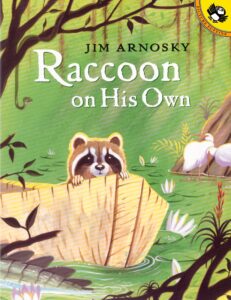
When a baby raccoon is swept downstream in an abandoned canoe, he feels afraid. But soon he notices all kinds of things he has never seen before, and from the safety of his little boat, he begins to explore the world around him. Paralleling the exciting-and often frightening-experience of a child’s first adventure away from home, Raccoon on His Own offers little ones a glimpse of being on their own for the very first time.
This action-filled forest book can be used in speech therapy to target rich vocabulary and sequencing. It is also great for describing and for targeting /r/ initial sounds! Discover more of the speech and language teaching concepts for using Raccoon On His Own in speech therapy below:
Frequent Speech Sounds:
/r/ initial (raccoon)
Themes:
forest
non-seasonal
Book Details:
Diverse Characters: N/A
Age Recommendation: Early Childhood, Elementary
Raccoon On His Own
By Jim Arnosky
Key Teaching Concepts
Narrative Structure:
action sequence
Narrative Concepts:
vocabulary
sequencing
illustration study
predicting
adjectives
verbs (regular past tense)
spatial concepts (where questions)
Sequencing:
order of animals raccoon sees that leads back to his family
Vocabulary:
dawned, nudged, downstream, sturdy, glided, alligator, warblers, churred, scattered, merganser, ducklings
Figurative Language:
simile (a new day dawned like a sleepy eye, opening slowly)
Grammar:
adjectives
verbs (regular past tense)
where questions (spatial concepts)
Inferencing:
How do you think the raccoon feels as the boat floats away?
Why did a chill run down his spine?
Why did the birds call out to him?
Why did the turtles scatter away?
How did the raccoon feel when he saw his family?
Predicting:
What do you think will happen to the raccoon as the boat floats away?
Do you think he will reach the branch?
Do you think he will climb the next branch? Why or why not?
What do you think made the great splash?
Who do you think the raccoon will see next?