
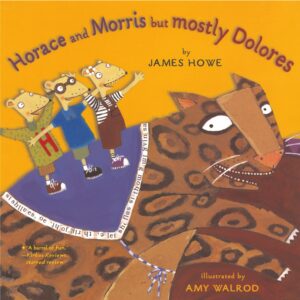
speech and language teaching concepts for Horace and Morris but Mostly Deloris in speech therapy​ ​
Frequent Speech Sounds:

/or/ medial
/s/ final

Themes:

non-seasonal
friendship
inclusion

Book Details:
Diverse Characters: N/A
Age Recommendation: Early Childhood, Elementary

Horace, and Morris, but Mostly Doloris

By James Howe

Will their friendship ever be the same? Horace, Morris, and Dolores have been best friends forever. They do everything together — from sailing the seven sewers to climbing Mount Ever-Rust. But one day Horace and Morris join the Mega-Mice (no girls allowed), and Dolores joins the Cheese Puffs (no boys allowed). Is this the end? Or will Horace and Morris but mostly Dolores find a way to save the day — and their friendship?

This cute friendship and /r/ themed book can be used in speech therapy to target social/emotional issues that arise from having friendships with girls and boys, and inferencing. It is also great for noticing illustrations and for targeting sounds including /r/ vocalic and /s/! Discover more of the speech and language teaching concepts for using Horace, and Morris, but Mostly Doloris in speech therapy below:

Key Teaching Concepts

Narrative Structure:

complete episode

Narrative Concepts:

theme/message​
problem solving​
illustration study​
inferencing
social/emotional​​
negation
text features​
phonological awareness​

Vocabulary:

adventure, decision, explore

Social/Emotional:

Horace, Morris and Dolores are the best of friends until they decide to play with only other girls or boys like the rest of the mice. Even though they miss each other, they say that they have to go to their clubhouses because that’s what girl/boy mice have to do. When Dolores doesn’t like the girl’s clubhouse anymore, she decides to find the boys and make their own clubhouse, with other friends too.

Figurative Language:

puns (seven sewers, Mount Ever- Rust)

Grammar:

verbs (mental state)
negation

Text Features:

change in text size
italics
dialogue
ellipses

Phonological Awareness:

rhyming

Inferencing:

Why is going on a cat’s back through fire daring?
Why do you think no mouse has ever done that before?
What do you think about their personalities?
Why do you think they didn’t want to do anything without Dolores?
Why do you think girls aren’t allowed there?
Do you think it’s right that they left Dolores out?
How do you think they feel about leaving Dolores out?
What does Dolores think about the boy’s clubhouse?
Why do you think Dolores wasn’t smiling as she stepped into the girl one?
Why do you think the other girls gasped?
How do the boys feel when the girls walk in?
How do they feel at the end?

Predicting:

What kind of adventures do you think they go on?
What do you think will happen to them?
What do you think they are doing there?
Do you think Dolores will go into the girl clubhouse?
What do you think she will do there?
What do you think will happen to their friendship?
What do you think Dolores and Chloris will do for some real fun?
What do you think they will do the next day?

Problem Solving:

Horace, Morris and Delores are forced to go their separate ways and play with other girls or boys. When Dolores realizes she isn’t having fun with the other girls, she comes up with a plan to solve her problem.